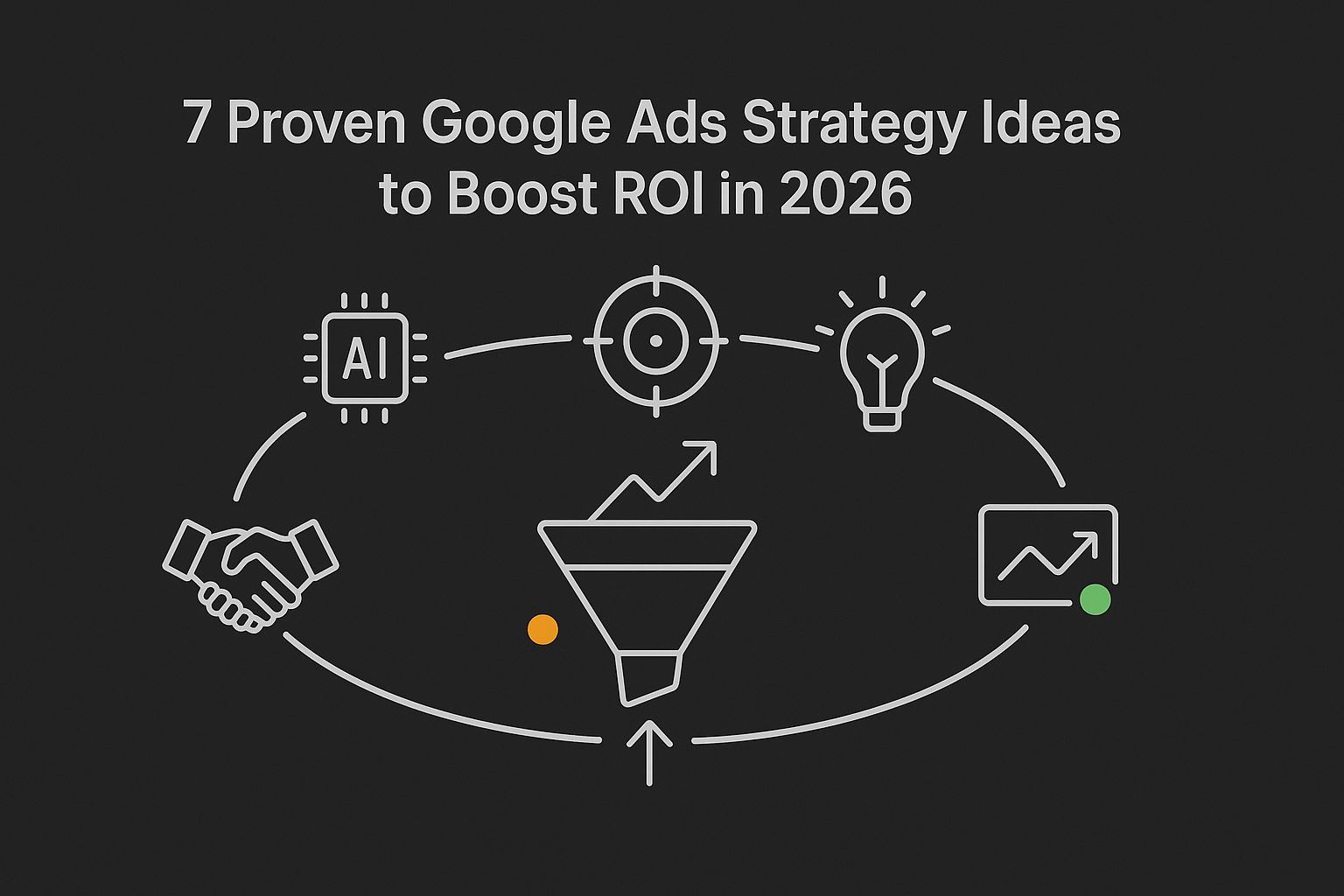
<p>Competition in Google Ads is fiercer than ever, and ad costs are climbing fast as we head into 2026. If you want to thrive in this new era, you need a google ads strategy that is both data-driven and adaptable.</p> <p>This guide will walk you through 7 actionable, expert-backed approaches designed to maximize ROI. We will cover campaign structure, automation, audience targeting, creative optimization, and more.</p> <p>You will see how real brands are winning with these methods, supported by the latest data and success stories. Ready to boost your results? Dive in and discover strategies that will keep you ahead in 2026.</p> <h2>The State of Google Ads in 2026: Trends & Challenges</h2> <p>The world of digital advertising is shifting faster than ever, and Google Ads is at the epicenter of this change. In 2026, brands are facing an environment where competition is fierce, and the cost of getting noticed keeps climbing. Relying on yesterday’s google ads strategy simply won’t cut it. Marketers now need to navigate a landscape shaped by relentless innovation, where every dollar counts and every click is scrutinized.</p> <p>AI-driven automation is no longer just a buzzword—it’s the engine behind most high-performing campaigns. Google has rolled out major updates that push automation and machine learning to the forefront, making campaign management both more efficient and more complex. At the same time, privacy regulations have tightened, forcing advertisers to rethink how they collect and use data for audience targeting. According to <a href="https://usermaven.com/blog/google-ads-benchmarks" target="_blank" rel="nofollow noopener noreferrer">Google Ads Benchmarks by Industry in 2026</a>, average CPCs have jumped by 18% year-over-year, while 70% of e-commerce budgets now flow into Performance Max campaigns. This data highlights the need for a strategic, future-focused google ads strategy.</p> <p>Let’s visualize some of these trends:</p> <table> <thead> <tr> <th>Metric</th> <th>2025 Value</th> <th>2026 Value</th> <th>Trend</th> </tr> </thead> <tbody><tr> <td>Avg. CPC (All Industries)</td> <td>$2.10</td> <td>$2.48</td> <td>▲ +18%</td> </tr> <tr> <td>Performance Max Share</td> <td>55%</td> <td>70%</td> <td>▲ Rapid Growth</td> </tr> <tr> <td>Conversion Rate</td> <td>4.3%</td> <td>3.9%</td> <td>▼ Slight Decline</td> </tr> </tbody></table> <p>Cross-channel integration is now mission-critical. Campaigns that unify Search, Display, YouTube, and Shopping—especially through Performance Max—are outperforming siloed efforts. The brands that thrived in 2025 were those that embraced automation and advanced segmentation, allowing them to adapt in real time and maximize reach. A modern google ads strategy must tap into these unified platforms, optimizing assets and signals across every touchpoint.</p> <p>However, new opportunities bring new challenges. Marketers are grappling with:</p> <ul> <li>Stricter data privacy laws and limited cookie tracking</li> <li>Attribution complexity as customer journeys span more channels</li> <li>Saturation from generic, repetitive ad creatives</li> </ul> <p>The old days of “set and forget” or broad targeting are fading fast. In 2026, a winning google ads strategy requires proactive management, creative testing, and data-driven decision-making. The brands that adapt, iterate, and leverage the latest tools will leave outdated competitors behind.</p> <img src="https://xqvnmkjynbkcujcrtubi.supabase.co/storage/v1/object/public/article-images/f8176546-9be8-4190-adf2-e7de1f405723/article-f8176546-9be8-4190-adf-a-clean-technical-infographic-illustrating-key-goo-0-myku3e.jpg" alt="The State of Google Ads in 2026: Trends & Challenges"><h2>Foundations for High-ROI Google Ads Campaigns</h2> <p>Building a high-ROI google ads strategy in 2026 starts long before you launch your first ad. The foundation you set determines how well your campaigns scale, adapt, and ultimately deliver the results your business needs.</p> <img src="https://xqvnmkjynbkcujcrtubi.supabase.co/storage/v1/object/public/article-images/f8176546-9be8-4190-adf2-e7de1f405723/article-f8176546-9be8-4190-adf-create-an-informational-diagram-showing-the-layere-1-i4shmj.jpg" alt="Foundations for High-ROI Google Ads Campaigns"><h3>Align Google Ads With Your Business Goals</h3> <p>Every effective google ads strategy starts with crystal-clear alignment to your business goals. Are you focused on scaling revenue, growing leads, driving signups, or boosting lifetime value? Pinpoint your primary objectives first.</p> <p>When your campaign KPIs directly support revenue targets, you can make smarter decisions about where to invest. This clarity also helps filter out distractions, so you are not chasing vanity metrics that do not move the needle.</p> <h3>Set SMART Objectives & Know Your Audience</h3> <p>Next, translate those business goals into SMART objectives—specific, measurable, achievable, relevant, and time-bound. Instead of “get more leads,” set a target like “increase qualified leads by 25% in Q1.”</p> <p>Audience research is the backbone of any google ads strategy. Use Google Analytics, first-party data, and AI-powered segmentation tools to build detailed buyer personas. Dig deep into user behaviors, pain points, and intent signals. The more granular your audience insights, the more relevant and effective your campaigns become.</p> <h3>Build a Smart Campaign Structure & Dynamic Budgets</h3> <p>A modern google ads strategy demands a thoughtful campaign structure. Organize your account around logical themes, segment ad groups by intent, and map keywords to each stage of the funnel. This approach makes optimization and scaling much easier.</p> <p>Budget allocation is not a set-and-forget task. Use a test-and-scale model: allocate a portion of spend to new ideas, then dynamically shift budgets toward top performers as data comes in. For a step-by-step breakdown, check out this guide to <a href="https://www.catchdigital.io/blog/the-modern-google-ads-production-process-how-to-set-your-campaigns-up-for-maximum-roi" target="_blank" rel="noopener noreferrer">modern Google Ads campaign setup</a>.</p> <h3>Why Strong Foundations Matter</h3> <p>Consider the SaaS company that restructured its google ads strategy to better align campaigns with revenue milestones and set up robust conversion tracking. The result? A measurable lift in ROI and the ability to quickly scale what worked.</p> <p>When you get the foundations right, every optimization—bidding, creative, targeting—has a bigger impact. A solid base gives you the flexibility to adapt fast in a changing landscape, ensuring your google ads strategy stays profitable and future-proof.</p> <h2>7 Proven Google Ads Strategy Ideas to Boost ROI in 2026</h2> <p>Unlocking ROI in 2026 means going far beyond the basics. The google ads strategy that worked last year might not move the needle now. In this section, we break down seven expert-backed strategies designed for today’s complexities—think automation, audience insights, creative innovation, advanced tracking, and full-funnel nurturing. Each tactic is actionable, data-driven, and field-tested for the new era.</p> <img src="https://xqvnmkjynbkcujcrtubi.supabase.co/storage/v1/object/public/article-images/f8176546-9be8-4190-adf2-e7de1f405723/article-f8176546-9be8-4190-adf-informational-diagram-showing-the-7-proven-google--2-mlethm.jpg" alt="7 Proven Google Ads Strategy Ideas to Boost ROI in 2026"><h3>1. Leverage AI-Powered Smart Bidding & Automation</h3> <p>AI is rewriting the rules for every google ads strategy in 2026. Google’s latest Smart Bidding options—like Maximize Conversion Value and Target ROAS—use real-time machine learning to optimize your bids. These algorithms analyze millions of signals, from device type and location to audience behavior and time of day, adapting instantly to changes in the auction.</p> <p>Imagine a retailer who switched from manual CPC to Smart Bidding and saw a 35% increase in ROAS. That’s not rare—according to Google, advertisers using Smart Bidding saw a 20% average jump in conversions in 2025.</p> <p>To get started, select the right bidding goal for your campaign. Set minimum and maximum bid limits to avoid runaway costs. Monitor performance closely, and don’t be afraid to adjust targets as you gather more data.</p> <p><strong>Tips for maximizing AI-powered bidding:</strong></p> <ul> <li>Always link your conversion tracking for accurate optimization</li> <li>Regularly review bid strategies and adjust based on business changes</li> <li>Pair automation with human oversight for best results</li> </ul> <p><strong>Pitfalls to avoid:</strong></p> <ul> <li>Over-relying on automation without checks</li> <li>Failing to set guardrails for your bids</li> </ul> <p>A modern google ads strategy blends advanced automation with strategic human input. This approach ensures you scale efficiently while staying aligned with your goals.</p> <h3>2. Build Hyper-Granular Audience Segments & Custom Intent Targeting</h3> <p>Generic targeting no longer cuts it for a winning google ads strategy. In 2026, advertisers are moving beyond age and gender. You need to drill into psychographics, purchase intent, and in-market signals to reach the right people at the right moment.</p> <p>Use first-party data and Customer Match to create custom segments. Layer these with intent audiences and remarketing lists for precision targeting. For example, a B2B company doubled its lead quality by combining custom intent with remarketing audiences.</p> <p>Segment your audiences by funnel stage, device, and engagement history. Employ lookalike audiences to find new high-value prospects, and use exclusion lists to reduce wasted spend.</p> <p><strong>Audience segmentation tactics:</strong></p> <ul> <li>Identify top-performing customer personas using Google Analytics</li> <li>Build custom segments based on recent site activity or product interests</li> <li>Exclude low-value or already converted audiences</li> </ul> <p>Advertisers using advanced segmentation cut wasted spend by 28%. An audience-first google ads strategy consistently outperforms keyword-only approaches, especially as privacy changes reshape targeting options.</p> <h3>3. Optimize for Performance Max & Cross-Channel Synergy</h3> <p>Performance Max campaigns have shifted the google ads strategy landscape. These campaigns unify Search, Display, YouTube, and Shopping into one powerful format, letting Google’s AI optimize placements across channels for maximum conversions.</p> <p>Start by setting up asset groups with diverse creatives. Feed in strong audience signals—such as your best-performing segments and first-party data—so the system can find new customers. Set clear conversion goals, and monitor reporting for actionable insights.</p> <p>An e-commerce brand that switched to Performance Max saw a 40% higher conversion rate compared to traditional campaigns. The key is creative variety and robust audience signals.</p> <p><strong>Tips for Performance Max success:</strong></p> <ul> <li>Diversify your creative assets (images, videos, headlines)</li> <li>Integrate branded and non-branded search campaigns for holistic growth</li> <li>Review performance reports to spot trends and double down on what works</li> </ul> <p>Pitfalls include running with too little creative variety or not tracking conversions correctly. When your google ads strategy leverages Performance Max and cross-channel data, you create synergy that drives sustainable growth.</p> <h3>4. Invest in Creative Testing & Ad Personalization at Scale</h3> <p>Ad fatigue is the enemy of any high-performing google ads strategy. In 2026, dynamic creative and responsive ads are essential to keep audiences engaged and drive results.</p> <p>A/B and multivariate tests let you experiment with headlines, descriptions, and visuals. AI-powered tools can generate new creative variations and predict winners before you spend big. For example, a brand saw its CTR soar by 60% after adopting dynamic creative optimization.</p> <p>Personalization tactics include ad customizers, location-based messaging, and countdown timers. According to industry data, personalized ads deliver 3x higher engagement rates.</p> <p><strong>Creative testing best practices:</strong></p> <ul> <li>Rotate fresh ad assets every few weeks</li> <li>Use dynamic elements to tailor messaging for each audience</li> <li>Leverage automated tools for rapid creative iteration</li> </ul> <p>If you want expert support in this area, explore <a href="https://www.catchdigital.io/service/ad-creative" target="_blank" rel="noopener noreferrer">creative ad services for Google Ads</a> to supercharge your campaigns.</p> <p>A robust google ads strategy requires ongoing creative refreshes and deep personalization. Continuous testing ensures you always have the right message at the right time.</p> <h3>5. Advanced Conversion Tracking, Attribution & Data Integration</h3> <p>In 2026, every google ads strategy must be built on rock-solid data. Google’s enhanced conversion tracking and Consent Mode help you stay privacy-compliant while capturing more conversion events.</p> <p>Set up offline conversion imports, phone call tracking, and CRM integrations. Use Google Tag Manager and server-side tracking for more accurate measurement. Adopt data-driven attribution models rather than last-click, so you see the true value of each touchpoint.</p> <p>A real estate business improved its lead-to-sale tracking by integrating Google Ads with their CRM. Advertisers using data-driven attribution saw a 15% lift in attributed conversions, unlocking smarter budget allocation.</p> <p><strong>Conversion tracking essentials:</strong></p> <ul> <li>Regularly audit your tags and data flows</li> <li>Use advanced attribution to inform optimization</li> <li>Integrate your CRM to close the loop on sales</li> </ul> <p>A data-integrated google ads strategy empowers you to optimize, measure, and scale with confidence.</p> <h3>6. Scale with Automated Rules, Scripts & Real-Time Optimization</h3> <p>Scaling your google ads strategy in 2026 means embracing automation beyond bidding. Automated rules help you adjust bids, pause underperformers, and pace budgets without manual effort.</p> <p>Google Ads scripts allow for bulk changes, anomaly detection, and custom reporting. For example, a SaaS company cut cost per acquisition by 22% using automated budget reallocation scripts.</p> <p>Monitor search terms, negative keywords, and audience shifts in real time. Combine automation tools with manual oversight for best-in-class performance.</p> <p><strong>Automation power moves:</strong></p> <ul> <li>Set rules to pause ads that exceed CPA thresholds</li> <li>Use scripts for daily reporting and budget adjustments</li> <li>Review automation logs weekly for anomalies</li> </ul> <p>Advertisers leveraging automation tools saved over 10 hours monthly on account management. Automation is a force multiplier, not a replacement for strategic thinking. Make it part of your google ads strategy to free up time for higher-level optimization.</p> <h3>7. Master Remarketing & Full-Funnel Audience Nurturing</h3> <p>Remarketing has evolved into a full-funnel powerhouse for any google ads strategy. With privacy changes, first-party data and Consent Mode are more important than ever.</p> <p>Segment your remarketing lists by user behavior, recency, and lifetime value. Use cross-channel remarketing—Display, YouTube, Gmail, and Customer Match—to stay top-of-mind. An e-commerce brand boosted repeat purchases by 30% using sequential remarketing.</p> <p><strong>Remarketing tactics:</strong></p> <ul> <li>Serve dynamic product ads to cart abandoners</li> <li>Personalize offers based on past interactions</li> <li>Exclude recent converters to avoid waste</li> </ul> <p>Remarketing campaigns deliver up to 50% lower CPA than prospecting. Nurturing users across the funnel is the secret sauce of a high-ROI google ads strategy. Focus on building relationships, not just one-off clicks.</p> <h2>Budgeting, Scaling, and Measuring Success in 2026</h2> <p>Setting the right budget for your google ads strategy in 2026 is more than a numbers game. It is about aligning every dollar with your business goals, ensuring you are not just spending, but truly investing. Begin by defining clear revenue targets and understanding what each campaign needs to deliver. Adopt practical frameworks like zero-based budgeting or performance-based allocation, both of which keep spend tied closely to ROI. For a deeper dive into campaign management, explore <a href="https://www.catchdigital.io/solutions/google-ads-management-calgary" target="_blank" rel="noopener noreferrer">Google Ads management strategies</a> to see how experts approach budget planning.</p> <img src="https://xqvnmkjynbkcujcrtubi.supabase.co/storage/v1/object/public/article-images/f8176546-9be8-4190-adf2-e7de1f405723/article-f8176546-9be8-4190-adf-a-clean-infographic-style-diagram-illustrating-the-3-vxngtx.jpg" alt="Budgeting, Scaling, and Measuring Success in 2026"><h3>Agile Scaling: Test, Learn, Repeat</h3> <p>A modern google ads strategy thrives on agility. Allocate 10-20% of your budget to testing new campaigns, creative assets, or audience segments. Monitor early results, then quickly shift additional funds toward top performers. This test-and-scale approach lets you discover new growth opportunities while minimizing risk. As your campaigns mature, roll out a dynamic budget model that enables you to double down on what works, week by week.</p> <ul> <li>Set aside a fixed percentage for experimentation</li> <li>Scale winners, pause underperformers</li> <li>Reassess allocations every 1-2 weeks</li> </ul> <p>This method keeps your google ads strategy nimble, ensuring you are always adapting to new trends and competitive moves.</p> <h3>Measuring What Matters: KPIs for 2026</h3> <p>Success in 2026 means tracking the right metrics, not just vanity numbers. Your google ads strategy should focus on KPIs that signal real business impact. Here is a quick-reference table:</p> <table> <thead> <tr> <th>KPI</th> <th>What It Measures</th> <th>Why It Matters</th> </tr> </thead> <tbody><tr> <td>ROAS</td> <td>Return on Ad Spend</td> <td>Profitability of campaigns</td> </tr> <tr> <td>CPA</td> <td>Cost Per Acquisition</td> <td>Efficiency of spend</td> </tr> <tr> <td>Conversion Rate</td> <td>% visitors taking action</td> <td>Ad and landing page quality</td> </tr> <tr> <td>CLV</td> <td>Customer Lifetime Value</td> <td>Long-term revenue potential</td> </tr> </tbody></table> <p>For advanced measurement and attribution, check out <a href="https://www.catchdigital.io/blog/advanced-utm-attribution-tracking-guide" target="_blank" rel="noopener noreferrer">Advanced UTM attribution tracking</a> to ensure you are capturing the full customer journey. Regularly review these KPIs to fine-tune your google ads strategy in real time.</p> <h3>Real-World Example and Essential Tools</h3> <p>Consider how a fitness brand doubled sales in Q2 2025 by adopting a rolling budget model. Instead of locking in monthly spend, they shifted budgets weekly based on real-time performance data, scaling high-ROAS campaigns and trimming low performers. Automated tools like budget pacing and anomaly detection helped them spot trends early and act fast.</p> <ul> <li>Use Google Ads’ built-in budget pacing</li> <li>Leverage anomaly detection for quick course corrections</li> <li>Schedule weekly performance reviews</li> </ul> <p>Continuous measurement, agile reporting, and a willingness to pivot are essential. In 2026, the most successful google ads strategy is one that combines data-driven decision-making with proactive, ongoing optimization.</p> <h2>Common Pitfalls and How to Avoid Them in Modern Google Ads</h2> <p>Navigating the modern Google Ads landscape in 2026 is as much about knowing what to avoid as it is about what to do. As businesses ramp up their google ads strategy, several pitfalls can quietly eat away at your ROI if left unchecked.</p> <div data-youtube-video> <iframe src="https://www.youtube.com/embed/aF4Wkwus98k" frameborder="0" allowfullscreen data-type="youtube" data-youtube-video-id="aF4Wkwus98k" ></iframe> </div> <h3>The Hidden Dangers Lurking in Automation</h3> <p>Automation has revolutionized the google ads strategy world, making campaign management more efficient. However, over-relying on automated bidding, rules, or scripts without regular human oversight can result in wasted spend and missed opportunities. For example, letting automation run unchecked may cause budgets to flow toward underperforming ads or ignore shifts in audience behavior.</p> <p>Another widespread issue is poor conversion tracking. If your google ads strategy is built on inaccurate or incomplete data, every optimization becomes guesswork. Not setting up enhanced conversions, failing to track phone calls, or forgetting offline sales can all distort your campaign's actual performance.</p> <h3>Real-World Example: When Attribution Goes Wrong</h3> <p>Consider a B2C company that lost 30% of its monthly budget due to misaligned attribution settings. The team depended solely on last-click attribution, missing the true value of upper-funnel touchpoints. This misstep led to aggressive cuts in awareness campaigns that were actually driving conversions later in the funnel.</p> <p>To avoid similar mistakes, follow this quick audit checklist for your google ads strategy:</p> <ul> <li>Review account structure for unnecessary overlap.</li> <li>Analyze search terms and negative keywords weekly.</li> <li>Check audience targeting for redundancy.</li> <li>Ensure conversion actions are mapped and tested.</li> <li>Rotate creative assets to avoid ad fatigue.</li> </ul> <p>For a deeper dive into how automation is changing the game, check out <a href="https://www.zestmediaco.com/ai-powered-ppc-how-google-ads-meta-are-using-ai-to-replace-manual-bidding-2025-update/" target="_blank" rel="nofollow noopener noreferrer">AI-Powered PPC Strategies in 2025</a>.</p> <table> <thead> <tr> <th>Pitfall</th> <th>Solution</th> </tr> </thead> <tbody><tr> <td>Over-reliance on automation</td> <td>Regular human audits</td> </tr> <tr> <td>Outdated creative</td> <td>Scheduled refresh cycles</td> </tr> <tr> <td>Weak conversion tracking</td> <td>Advanced setup + testing</td> </tr> <tr> <td>Ignored negatives</td> <td>Weekly search term review</td> </tr> <tr> <td>Misaligned attribution</td> <td>Quarterly model reviews</td> </tr> </tbody></table> <h3>Stay Ahead: Proactive Education and Continuous Improvement</h3> <p>The pace of change in google ads strategy means yesterday’s playbook can quickly become obsolete. Ignoring new features, privacy regulations, or audience tools can make your campaigns less competitive. According to recent findings, advertisers who conducted quarterly audits improved their ROI by 18% on average.</p> <p>Keep learning by subscribing to reputable industry blogs and tracking <a href="https://www.sharpinnovations.com/blog/2025/11/google-ads-trends-and-technologies-2026/" target="_blank" rel="nofollow noopener noreferrer">Google Ads Trends and Technologies 2026</a>. Make ongoing education and hands-on optimization a core part of your google ads strategy.</p> <p>Success in 2026 is not about “set and forget.” It’s about regular check-ins, creative thinking, and adapting your approach as the advertising landscape evolves.<br><br>If you’re serious about outsmarting rising ad costs and making your Google Ads budget work harder in 2026, it’s time to put these strategies into action. We’ve covered everything from campaign structure to advanced automation and full-funnel nurturing—now let’s tailor these insights to your unique business goals. I’d love to help you build a predictable, scalable system that actually delivers the ROI you’re after. Ready to see what’s possible for your growth journey?<br><a href="https://www.catchdigital.io/book-a-consultation" target="_blank" rel="noopener noreferrer">Book a Strategy Call</a><br>and let’s map out your next winning moves together.</p>