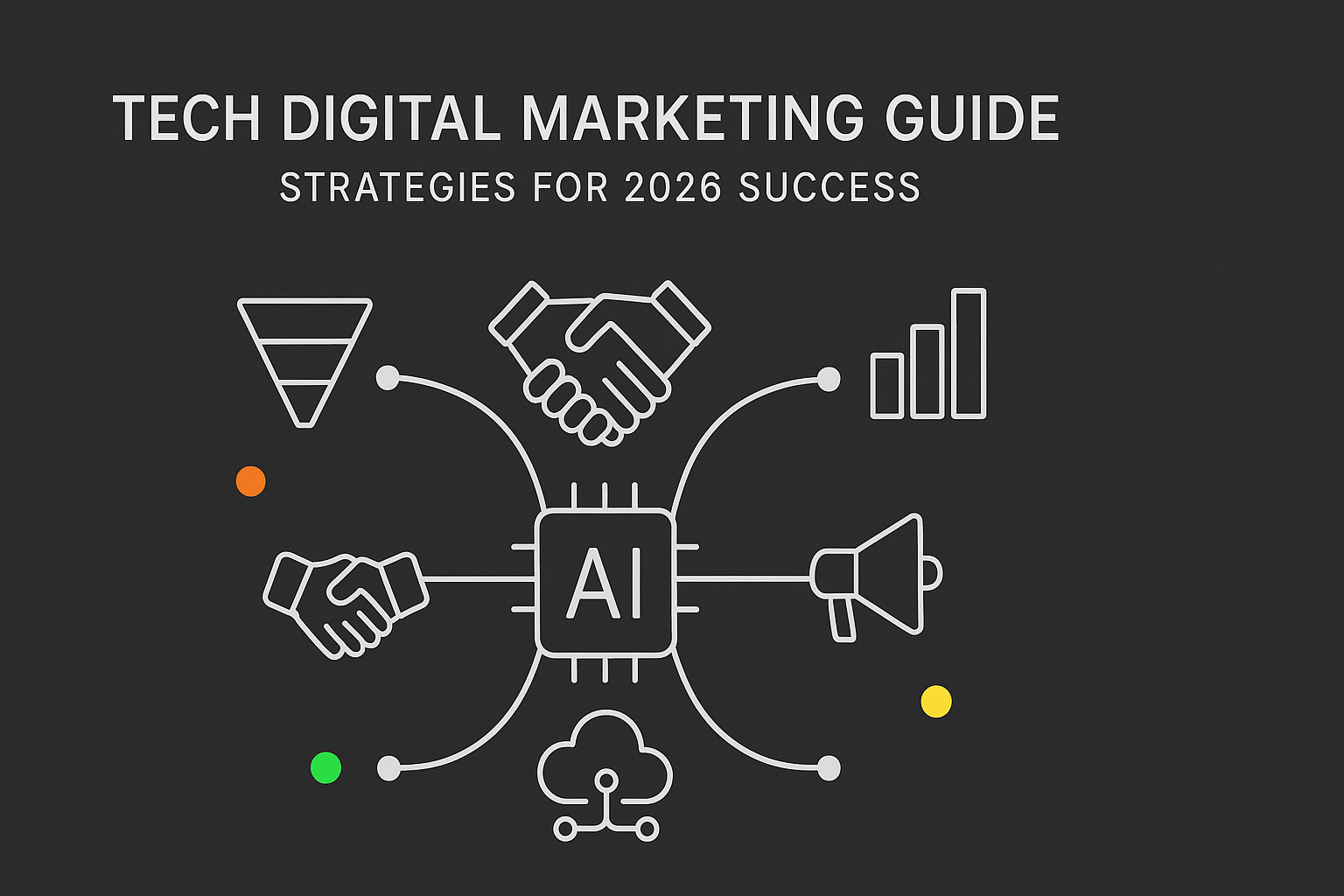
<p>In 2026, tech companies must adapt fast or risk falling behind. The digital landscape shifts daily, making it clear that yesterday’s playbook no longer secures tomorrow’s growth.</p> <p>This guide reveals the most effective tech digital marketing strategies designed for measurable success. We’ll unpack the latest trends, from AI-driven personalization to data analytics, ensuring you stay ahead in a fiercely competitive space.</p> <p>Discover step-by-step tactics for SEO, content, paid ads, and omnichannel integration. Ready to future-proof your marketing and drive results? Dive in for actionable insights that turn ambition into scalable growth.</p> <h2>The 2026 Tech Digital Marketing Landscape: Trends & Challenges</h2> <p>The world of tech digital marketing in 2026 is nothing short of a high-speed race. Tech marketers face a perfect storm of evolving buyer behaviors, exploding digital channels, and tightening privacy rules. To help you keep pace, let’s break down the key trends and challenges shaping the landscape.</p> <img src="https://xqvnmkjynbkcujcrtubi.supabase.co/storage/v1/object/public/article-images/b01b4d70-af12-40a3-a03a-b79bc0e48f2e/article-b01b4d70-af12-40a3-a03-a-clean-infographic-style-diagram-with-a-f8f8f8-ba-0-bw2zlw.jpg" alt="The 2026 Tech Digital Marketing Landscape: Trends & Challenges"><h3>Shifting Buyer Behaviors and Expectations</h3> <p>Remote work is now the default for many, with virtual collaboration shaping how tech buyers research and connect. These buyers crave hyper-personalized and interactive experiences across every digital touchpoint. According to startupbonsai.com, 80% of consumers prefer brands that offer personalization. For tech digital marketing, this means static content and generic campaigns are out. Instead, dynamic engagement and tailored value are the new minimum standards.</p> <ul> <li>Surge in demand for interactive content</li> <li>Preference for brands that “get” the buyer</li> <li>Need for adaptive messaging in tech digital marketing</li> </ul> <h3>Evolving Digital Channels and Technologies</h3> <p>By 2026, social media users are projected to exceed 4.5 billion, amplifying the reach and complexity of tech digital marketing. AI-powered tools and automation are now table stakes, with chatbots, predictive analytics, and smart segmentation driving efficiency. Video, AR, VR, and immersive experiences have taken center stage, offering new ways for tech brands to stand out and connect. Check out the latest <a href="https://hostadvice.com/blog/digital-marketing/digital-marketing-statistics/" target="_blank" rel="nofollow noopener noreferrer">Digital Marketing Statistics 2026: Latest Trends & Insights</a> for more data on these shifts.</p> <ul> <li>AI and automation reshape engagement</li> <li>Video and AR/VR boost conversion rates</li> <li>Omnichannel presence is a must for tech digital marketing</li> </ul> <h3>Data Privacy, Compliance, and Trust</h3> <p>Heightened regulations like GDPR, CCPA, and new global standards have made compliance non-negotiable in tech digital marketing. Consumers are more aware and cautious about how their data is collected and used. Transparency, ethical data practices, and clear privacy policies are now essential for building trust. Brands that neglect privacy risk damaging their reputation and losing business.</p> <ul> <li>Increased legal scrutiny</li> <li>Higher consumer expectations for transparency</li> <li>Need for proactive compliance in tech digital marketing</li> </ul> <h3>Competitive Saturation in Tech Markets</h3> <p>With over 80% of U.S. adults online daily (pewresearch.org), the digital marketplace for tech is more crowded than ever. Standing out is no longer just about flashy ads or clever copy. Tech digital marketing strategies must focus on clear differentiation, authentic value, and thought leadership. The brands that win are those who carve out a unique voice and deliver consistent, meaningful experiences.</p> <ul> <li>Fierce competition for attention</li> <li>Demand for originality in tech digital marketing</li> <li>Value-driven messaging is key</li> </ul> <h3>The Decline of Third-Party Cookies</h3> <p>The end of third-party cookies has thrown a wrench into traditional tracking, retargeting, and attribution methods. Tech digital marketing teams must now double down on first-party data strategies, building direct relationships with their audience. This shift forces marketers to rethink how they measure success and reach the right prospects.</p> <ul> <li>Loss of granular tracking</li> <li>Rise of privacy-first retargeting</li> <li>Emphasis on owned data in tech digital marketing</li> </ul> <h3>The Need for Agile, Measurable Marketing</h3> <p>Gone are the days of set-it-and-forget-it campaigns. Tech digital marketing in 2026 is all about agility, with a demand for ROI-driven strategies and transparent reporting. Marketers must be ready to experiment, learn fast, and pivot as trends shift. The pressure is on to deliver measurable, scalable growth in real time.</p> <ul> <li>Test-and-learn frameworks</li> <li>Real-time analytics and dashboards</li> <li>Continuous adaptation is the new norm</li> </ul> <h2>Building a Future-Proof Tech Marketing Strategy</h2> <p>Staying ahead in tech digital marketing means building strategies that flex with change. The right approach balances innovation, data, and collaboration. Let’s break down the steps to ensure your marketing remains agile, measurable, and ready for whatever 2026 brings.</p> <img src="https://xqvnmkjynbkcujcrtubi.supabase.co/storage/v1/object/public/article-images/b01b4d70-af12-40a3-a03a-b79bc0e48f2e/article-b01b4d70-af12-40a3-a03-a-modern-infographic-style-diagram-showing-the-six-1-z8kjvq.jpg" alt="Building a Future-Proof Tech Marketing Strategy"><h3>Defining Business Objectives and Success Metrics</h3> <p>Start with clarity. Your tech digital marketing plan must align tightly with business growth goals. Are you chasing pipeline expansion, higher-quality leads, or improved ROI? Set KPIs that matter.</p> <table> <thead> <tr> <th>Objective</th> <th>KPI Example</th> <th>Why It Matters</th> </tr> </thead> <tbody><tr> <td>Pipeline Growth</td> <td># of SQLs</td> <td>Drives revenue</td> </tr> <tr> <td>Lead Quality</td> <td>MQL to SQL Ratio</td> <td>Focuses on conversion</td> </tr> <tr> <td>CAC Optimization</td> <td>Customer Acquisition Cost</td> <td>Controls spend</td> </tr> <tr> <td>LTV Expansion</td> <td>Lifetime Value</td> <td>Measures customer retention</td> </tr> <tr> <td>ROI Tracking</td> <td>Campaign ROI</td> <td>Proves marketing impact</td> </tr> </tbody></table> <p>Revisit objectives quarterly to keep your tech digital marketing strategy on track and responsive.</p> <h3>Audience Research and Persona Development</h3> <p>Understanding your buyer is non-negotiable in tech digital marketing. Tech buyers’ needs shift quickly, so your personas must too. Use these research methods:</p> <ul> <li>Analyze intent data for real-time interests</li> <li>Study behavioral analytics for journey mapping</li> <li>Run feedback loops through surveys and interviews</li> </ul> <p>Keep personas fresh by integrating insights from sales and customer success. This way, tech digital marketing campaigns always hit the mark.</p> <h3>Mapping the Customer Journey in 2026</h3> <p>2026 brings more touchpoints than ever. Identify where your audience interacts: website, social, email, virtual events, and beyond. A seamless omnichannel experience is key.</p> <p>Leverage platforms and tools to map each step, ensuring messaging and branding feel unified. For a deep dive on customer journey mapping, explore <a href="https://www.catchdigital.io/blog/customer-digital" target="_blank" rel="noopener noreferrer">Building customer digital journeys</a>.</p> <p>Align your tech digital marketing with these journeys to boost engagement and conversions.</p> <h3>Budgeting for Innovation and Experimentation</h3> <p>Innovation needs investment. Allocate budget for new tech digital marketing channels, such as AR campaigns, AI chatbots, or voice search experiments.</p> <p>Benchmark spend against industry averages, but leave room for pilot projects and quick pivots. Track ROI closely, so you can double down where results are strongest and cut what’s not working.</p> <h3>Agile Strategy and Iteration</h3> <p>Rapid change is the norm in tech digital marketing. Adopt a test-and-learn mindset. Run experiments, A/B tests, and iterate based on real data.</p> <p>Build in regular review cycles. If a channel underperforms, pivot fast. If a new trend emerges, be ready to trial it. Agility ensures your strategy never gets stale.</p> <h3>Cross-Functional Collaboration</h3> <p>No tech digital marketing plan succeeds in a silo. Marketing, sales, product, and customer success teams must collaborate.</p> <p>Share insights, align messaging, and keep everyone focused on unified goals. Regular syncs and shared dashboards drive transparency and accountability.</p> <p>A future-proof strategy is a team sport—make sure everyone’s playing.</p> <h2>Step 1: Advanced SEO & Content Marketing for Tech Companies</h2> <p>Staying visible in the tech digital marketing space means mastering both advanced SEO and content strategies. In 2026, search and content are more intertwined than ever, and getting them right is the foundation of digital growth for tech firms.</p> <img src="https://xqvnmkjynbkcujcrtubi.supabase.co/storage/v1/object/public/article-images/b01b4d70-af12-40a3-a03a-b79bc0e48f2e/article-b01b4d70-af12-40a3-a03-a-clean-infographic-style-diagram-showing-the-inte-2-2ltkhl.jpg" alt="Step 1: Advanced SEO & Content Marketing for Tech Companies"><h3>Evolving SEO in the Age of AI and Search 3.0</h3> <p>SEO has shifted from simple keyword targeting to a focus on user intent and context. AI-driven search engines now prioritize content that demonstrates expertise, experience, authority, and trustworthiness (E-E-A-T). For tech digital marketing, this means organizing your site around topic clusters and answering real user questions, not just stuffing keywords.</p> <p>Consider this: 68% of all online experiences start with a search engine. To succeed, tech brands must map buyer journeys and create content that addresses each stage, from discovery to decision. Leverage AI tools to optimize content for both users and algorithms, ensuring your site remains relevant as search evolves.</p> <h3>Technical SEO for Complex Tech Sites</h3> <p>Technical SEO is the backbone of any successful tech digital marketing strategy. Fast site speed, mobile optimization, and robust schema markup are non-negotiable. In 2026, Google’s algorithms reward sites that load quickly, are accessible on any device, and use structured data to clarify content.</p> <p>International reach is another challenge. Tech brands often operate in multiple regions, so addressing hreflang tags, multi-language content, and local SEO is critical. For a deep dive into these essentials, check out this <a href="https://www.catchdigital.io/blog/webflow-technical-seo-guide" target="_blank" rel="noopener noreferrer">Advanced SEO for tech websites</a> guide, which covers everything from schema to site architecture.</p> <p>Prioritize regular technical audits and monitor core web vitals to prevent issues before they impact rankings.</p> <h3>Content Marketing That Converts in 2026</h3> <p>Content marketing remains a powerhouse for tech digital marketing, with 82% of marketers relying on it to drive results. The key in 2026 is to move beyond generic blogs. Instead, create high-value assets like whitepapers, webinars, and case studies that showcase industry knowledge.</p> <p>Thought leadership is essential for earning trust in tech. Use data-driven storytelling to highlight real-world results and unique insights. Encourage collaboration between subject matter experts and content creators to ensure accuracy and depth. Always align content with buyer personas to address their specific challenges and needs.</p> <h3>Video, Interactive, and Immersive Content</h3> <p>Video content continues to surge in tech digital marketing. Explainer videos, product demos, and live streams help simplify complex solutions and engage audiences. Platforms like YouTube dominate B2C, while LinkedIn remains the go-to for B2B video.</p> <p>Looking ahead, AR and VR experiences are becoming more mainstream. Interactive product tours and immersive demos allow prospects to experience tech solutions firsthand. Use these formats to differentiate your brand and capture attention in crowded feeds.</p> <p>Consider integrating quizzes, calculators, or interactive infographics to boost engagement and time on site.</p> <h3>Content Syndication and Amplification</h3> <p>Creating great content is only half the battle in tech digital marketing. Syndication and amplification ensure your message reaches the right audience. Partner with trusted industry platforms to extend your reach and build credibility.</p> <p>Influencer collaborations are especially effective in tech, lending authenticity and tapping into established communities. Identify thought leaders whose audience matches your buyer personas. Use co-branded webinars, guest posts, or social takeovers to expand your influence.</p> <p>Track performance across channels to optimize your amplification mix and maximize ROI.</p> <h3>Measurement and Continuous Optimization</h3> <p>Measurement is the heartbeat of tech digital marketing. Rely on analytics to track engagement, lead generation, and attribution across every piece of content. Use dashboards to visualize which topics, formats, and channels drive the highest pipeline impact.</p> <p>Continuous improvement is essential. Gather feedback from both analytics and direct user input to refine your strategy. Run A/B tests on headlines, CTAs, and formats to see what resonates.</p> <p>Share key insights across teams to ensure everyone is aligned and moving toward shared goals.</p> <h2>Step 2: Omnichannel Paid Advertising & Demand Generation</h2> <p>In 2026, tech digital marketing demands a holistic approach to paid media. Omnichannel campaigns aren’t just a buzzword—they’re the engine for scalable growth in a fiercely competitive tech landscape. Let’s break down how to unify platforms, harness AI, and drive demand generation that actually moves the needle.</p> <img src="https://xqvnmkjynbkcujcrtubi.supabase.co/storage/v1/object/public/article-images/b01b4d70-af12-40a3-a03a-b79bc0e48f2e/article-b01b4d70-af12-40a3-a03-a-modern-informational-diagram-showing-the-omnicha-3-heoa55.jpg" alt="Step 2: Omnichannel Paid Advertising & Demand Generation"><h3>Multi-Platform Paid Media Strategies</h3> <p>Today’s tech digital marketing is all about meeting buyers where they are. With decision-makers spread across Google, LinkedIn, Meta, and niche channels, a unified paid media mix is essential. </p> <p>To maximize impact:</p> <ul> <li>Orchestrate campaigns across Google Ads, LinkedIn, Meta, and programmatic platforms.</li> <li>Balance upper-funnel brand awareness with lower-funnel lead generation.</li> <li>Sync ad messaging and creative to ensure a seamless brand experience.</li> </ul> <p>For deeper insights on running high-performing campaigns, explore this comprehensive <a href="https://www.catchdigital.io/blog/google-ads-strategy" target="_blank" rel="noopener noreferrer">Google Ads strategy for tech</a> guide. Diversifying spend across channels keeps your brand top-of-mind and your pipeline full.</p> <h3>AI-Driven Ad Targeting and Optimization</h3> <p>AI is redefining targeting in tech digital marketing. Instead of static segments, machine learning now analyzes real-time behavior, adjusting bids and creative on the fly.</p> <p>Key tactics:</p> <ul> <li>Use AI to segment audiences based on intent, engagement, and lifecycle stage.</li> <li>Deploy dynamic creative optimization for hyper-relevant ads.</li> <li>Let algorithms handle bid management, so budgets flow to what’s working.</li> </ul> <p>With AI, you can personalize ads at scale, adapt to shifting buyer patterns, and consistently improve performance.</p> <h3>Retargeting in a Cookieless World</h3> <p>The decline of third-party cookies is reshaping retargeting in tech digital marketing. Instead of relying on old tracking methods, focus on building robust first-party data assets.</p> <p>Strategies to consider:</p> <ul> <li>Encourage site registrations and gated content downloads to grow your own audience pool.</li> <li>Use server-side tracking and privacy-safe identifiers for retargeting.</li> <li>Build lookalike audiences from your high-value customer segments.</li> </ul> <p>This shift not only protects privacy but also future-proofs your demand generation as regulations evolve.</p> <h3>Leveraging Account-Based Marketing (ABM)</h3> <p>ABM is the secret weapon for precision in tech digital marketing. Rather than casting a wide net, ABM zeroes in on specific accounts with tailored ad journeys and content.</p> <p>Winning ABM tactics:</p> <ul> <li>Map key accounts and decision-makers.</li> <li>Serve personalized ads synced with email and content touchpoints.</li> <li>Align with sales to coordinate outreach and track influence across the buying committee.</li> </ul> <p>ABM makes every marketing dollar count, especially when targeting enterprise or high-value tech buyers.</p> <h3>Measuring and Scaling Paid Campaigns</h3> <p>In tech digital marketing, what gets measured gets improved. Use unified dashboards to track performance across every channel, campaign, and audience.</p> <p>Sample ROI Metric Table:</p> <table> <thead> <tr> <th>Channel</th> <th>CAC</th> <th>Pipeline Generated</th> <th>ROI (%)</th> </tr> </thead> <tbody><tr> <td>Google Ads</td> <td>$120</td> <td>$500K</td> <td>320</td> </tr> <tr> <td>LinkedIn</td> <td>$150</td> <td>$400K</td> <td>260</td> </tr> <tr> <td>Programmatic</td> <td>$100</td> <td>$350K</td> <td>210</td> </tr> </tbody></table> <p>Actions for scale:</p> <ul> <li>Monitor real-time performance and optimize quickly.</li> <li>Run A/B tests to refine messaging and creative.</li> <li>Share insights with cross-functional teams to inform future campaigns.</li> </ul> <p>Consistent measurement ensures your paid media strategy stays agile and delivers lasting impact.</p> <h2>Step 3: Social Media, Community, and Influencer Marketing</h2> <p>Social media is the heartbeat of tech digital marketing in 2026. With billions of users and endless platforms to choose from, tech brands are finding new ways to connect, build trust, and drive measurable results. Let’s break down the essentials for success.</p> <h3>Platform Selection and Strategy for Tech Brands</h3> <p>Choosing the right social platforms is critical in tech digital marketing. LinkedIn leads for B2B, supporting product launches, thought leadership, and direct engagement with decision-makers. YouTube is the go-to for demos and deep dives, while niche forums like Reddit and Discord foster authentic conversations.</p> <p>With social users set to surpass 4.5 billion by 2026, brands must adapt quickly. Evaluate where your audience spends their time, then tailor content and campaigns for each channel. Want to stay ahead of the curve? Explore <a href="https://www.searchenginejournal.com/digital-marketing-trends/478799/" target="_blank" rel="nofollow noopener noreferrer">The Top 10 Digital Marketing Trends For 2026</a> to ensure your platform choices align with emerging behaviors.</p> <h3>Building Authentic Brand Communities</h3> <p>Communities are the new currency in tech digital marketing. Buyers crave connection, not just content. Host live Q&A sessions, behind-the-scenes tours, and interactive events to make your brand more human.</p> <p>Encourage employee advocacy by spotlighting your team’s expertise. Share customer success stories to boost credibility. The result? Deeper loyalty, more organic reach, and a network that champions your brand even when you’re not in the room.</p> <h3>Influencer and Thought Leader Partnerships</h3> <p>Influencer marketing has become a powerhouse within tech digital marketing. Partnering with industry experts instantly elevates your credibility and extends your reach. In 2026, the influencer market is projected to hit $16.4 billion.</p> <p>Choose partners who genuinely align with your values and audience. Micro-influencers, especially in tech, often deliver higher engagement and trust than mega-celebrities. Collaborate on webinars, product reviews, and co-authored content to amplify your message.</p> <h3>Social Listening and Real-Time Engagement</h3> <p>Social listening is a non-negotiable in tech digital marketing. Use advanced tools to track conversations, monitor sentiment, and spot trends before your competitors do.</p> <p>Responding in real time builds trust and shows you value feedback. Whether it’s addressing a product question or jumping in on a trending topic, agility is your secret weapon. This approach also helps you manage crises before they escalate.</p> <h3>Analytics and Social ROI</h3> <p>Measuring impact is at the core of tech digital marketing. Go beyond vanity metrics—track engagement, share of voice, and the actual pipeline generated from social efforts.</p> <p>Leverage dashboards that visualize key metrics across platforms. Use these insights to refine your strategy, double down on what works, and pivot fast when audience preferences shift. Data-driven decisions keep your brand growing, no matter how crowded the digital space becomes.</p> <h2>Step 4: Email, Automation, and Personalization at Scale</h2> <p>Email remains the powerhouse of tech digital marketing, delivering personalized messages right to your audience’s inbox. For tech brands in 2026, standing out means blending strategy with smart tools to engage, nurture, and convert leads at scale. Let’s break down how to future-proof your email approach and maximize results.</p> <h3>Modern Email Marketing for Tech Audiences</h3> <p>In 2026, email is still the preferred channel for B2B and B2C tech digital marketing. According to OptinMonster, 61 percent of consumers want to hear from brands via email, making it crucial for tech companies to get segmentation right.</p> <p>Segment your lists by lifecycle stage, industry, and intent signals. Tailor content to each segment, whether it’s onboarding, product updates, or re-engagement. Use concise, value-driven subject lines to cut through inbox noise.</p> <p>Effective segmentation boosts open rates and ensures your tech digital marketing messages land with impact. Regular list hygiene and preference centers help keep your audience engaged and compliant.</p> <h3>Automation and Lead Nurturing Workflows</h3> <p>Automation is at the core of scalable tech digital marketing. Set up triggered sequences for key events—like sign-ups, downloads, or demo requests. Behavioral drip campaigns nurture prospects based on their actions, moving them through the funnel without manual intervention.</p> <p>Integrate email automation with your CRM and sales enablement tools. This ensures every lead receives timely, relevant messaging. Use re-engagement flows to win back inactive contacts and maximize your database value.</p> <p>With automation, tech digital marketing teams can deliver consistent experiences, freeing up resources for strategy and creative work.</p> <h3>AI-Powered Personalization</h3> <p>AI takes tech digital marketing to the next level with hyper-personalized content. Dynamic emails adjust messaging, product recommendations, and visuals based on real-time user data. Predictive analytics determine the best send times and content for each recipient.</p> <p>AI analyzes behavior to refine targeting and optimize campaigns for engagement and conversions. For a deep dive into how AI is transforming content and personalization, see <a href="https://promptaijournal.org/revista/article/view/91" target="_blank" rel="nofollow noopener noreferrer">AI Marketing: Automating Creativity for Digital Campaigns</a>.</p> <p>Personalization powered by AI ensures your tech digital marketing feels one-to-one, even at scale.</p> <h3>Compliance and Deliverability Best Practices</h3> <p>Regulations like GDPR and CAN-SPAM are non-negotiable in tech digital marketing. Always obtain explicit consent before sending emails, and make it easy to unsubscribe. Monitor sender reputation and engagement metrics to avoid deliverability issues.</p> <p>Keep your data practices transparent, and regularly update your privacy policies. Use double opt-in and authentication protocols (SPF, DKIM, DMARC) to boost trust and inbox placement.</p> <p>A strong compliance and deliverability framework protects your brand and ensures your tech digital marketing efforts reach the right eyes.</p> <h2>Step 5: Data, Analytics, and Measuring ROI in 2026</h2> <p>In 2026, data is the backbone of every successful tech digital marketing strategy. With evolving privacy laws and rapidly advancing analytics tools, tech companies must build smarter, more integrated systems to track, measure, and optimize results. Let’s break down the essentials for future-ready measurement and ROI.</p> <h3>Building a Unified Marketing Data Stack</h3> <p>A unified data stack is vital for tech digital marketing in 2026. Integrate platforms like Google Analytics 4, CRM tools, and ad tracking to centralize all your insights. Focus on first-party data collection, as third-party cookies continue to phase out. Use web analytics, product usage data, and customer feedback to enrich your understanding of buyer behavior.</p> <p>With a seamless stack, you can align sales, marketing, and customer success around shared metrics. For a deeper dive on building growth-focused, data-driven systems, check out these <a href="https://www.catchdigital.io/blog/digital-growth-marketing" target="_blank" rel="noopener noreferrer">digital growth marketing strategies</a>. This foundation ensures your tech digital marketing efforts are measurable and scalable.</p> <h3>Attribution in a Privacy-First Era</h3> <p>Attribution is evolving fast in tech digital marketing. With stricter privacy rules and fewer third-party cookies, old models like last-click are losing effectiveness. Multi-touch and algorithmic attribution now offer a clearer picture of the full customer journey.</p> <p>Leverage server-side tracking and privacy-safe tools to connect touchpoints across your stack. Adapt your tech digital marketing to focus on first-party data, using unique identifiers and consent-based tracking. This approach helps you understand what drives conversions and where to invest next.</p> <h3>Actionable Dashboards and Reporting</h3> <p>Dashboards are the heartbeat of tech digital marketing measurement. Build real-time, customizable views that track every channel and campaign. Key metrics like pipeline growth, CAC, LTV, and channel ROI should be front and center for your team.</p> <p>Use clear data visualizations so everyone, from marketing to leadership, can spot trends and act fast. Share insights regularly to keep your tech digital marketing strategy agile and outcome-focused. The right dashboards empower data-driven decision making at all levels.</p> <h3>Using Insights for Continuous Improvement</h3> <p>Continuous improvement is the secret sauce in tech digital marketing. Analyze campaign data, run A/B tests, and use feedback loops to refine your tactics. Share findings across teams to spark new ideas and keep everyone aligned.</p> <p>Set up regular reviews to track progress, celebrate wins, and quickly pivot when results stall. By embedding experimentation into your culture, your tech digital marketing will stay ahead of competitors and adapt to the changing digital landscape.</p> <h2>Future-Proofing Your Tech Digital Marketing: Continuous Learning & Adaptation</h2> <p>Staying ahead in tech digital marketing means never standing still. The pace of change is relentless, so future-proofing your strategy requires a mindset of continuous learning, experimentation, and adaptation.</p> <h3>Staying Ahead of Emerging Tech and Trends</h3> <p>The tech digital marketing landscape evolves almost daily. To keep pace, monitor new advancements like AI, AR/VR, voice search, and emerging social platforms. Attend industry events, join webinars, and prioritize ongoing training. For deeper insight into how AI is transforming marketing strategy, explore this review on <a href="https://link.springer.com/article/10.1007/s44362-025-00020-7" target="_blank" rel="nofollow noopener noreferrer">Artificial Intelligence Embeddedness in Marketing</a>. Staying proactive ensures your team can spot trends early and seize opportunities before competitors do.</p> <h3>Building a Culture of Experimentation</h3> <p>Future-proofing tech digital marketing is about more than just tools; it’s about mindset. Foster a culture where pilot programs, rapid prototyping, and test-and-learn frameworks are the norm. Encourage teams to share results openly, whether campaigns succeed or fail. Reward curiosity and celebrate lessons learned. This approach helps your organization adapt quickly and discover scalable strategies that drive growth.</p> <ul> <li>Launch quick experiments on new platforms</li> <li>Document and share findings internally</li> <li>Recognize creative risk-takers</li> </ul> <h3>Investing in Talent and Technology</h3> <p>Your tech digital marketing success depends on having the right talent and tools. Upskill your team in areas like data analysis, automation, and creative problem-solving. Adopt a flexible martech stack that can scale as your needs evolve. Prioritize technology that integrates seamlessly, supports omnichannel strategies, and enables agile marketing. Remember, people and platforms together build your long-term competitive edge in tech digital marketing.</p> <h3>Embracing Radical Transparency and Trust</h3> <p>Transparency is the foundation for sustainable marketing. Report openly on both wins and setbacks. Build trust with your audience by using data ethically and messaging authentically. Encourage open dialogue between teams, and invite customer feedback. This commitment to honesty not only strengthens brand reputation but also creates a culture that thrives on trust and accountability.<br><br>So, you’ve seen how the digital marketing game is changing fast—and why tech businesses like yours need smart, adaptable strategies to thrive in 2026. If you’re ready to turn these insights into real growth, let’s make it personal. We can dive into your goals, map out a step by step action plan, and build a system that actually delivers predictable results. You don’t have to guess what’s next or go it alone. If you want clarity on what will work for your business, let’s connect and <a href="https://www.catchdigital.io/book-a-consultation" target="_blank" rel="noopener noreferrer">Book a Strategy Call</a>.</p>