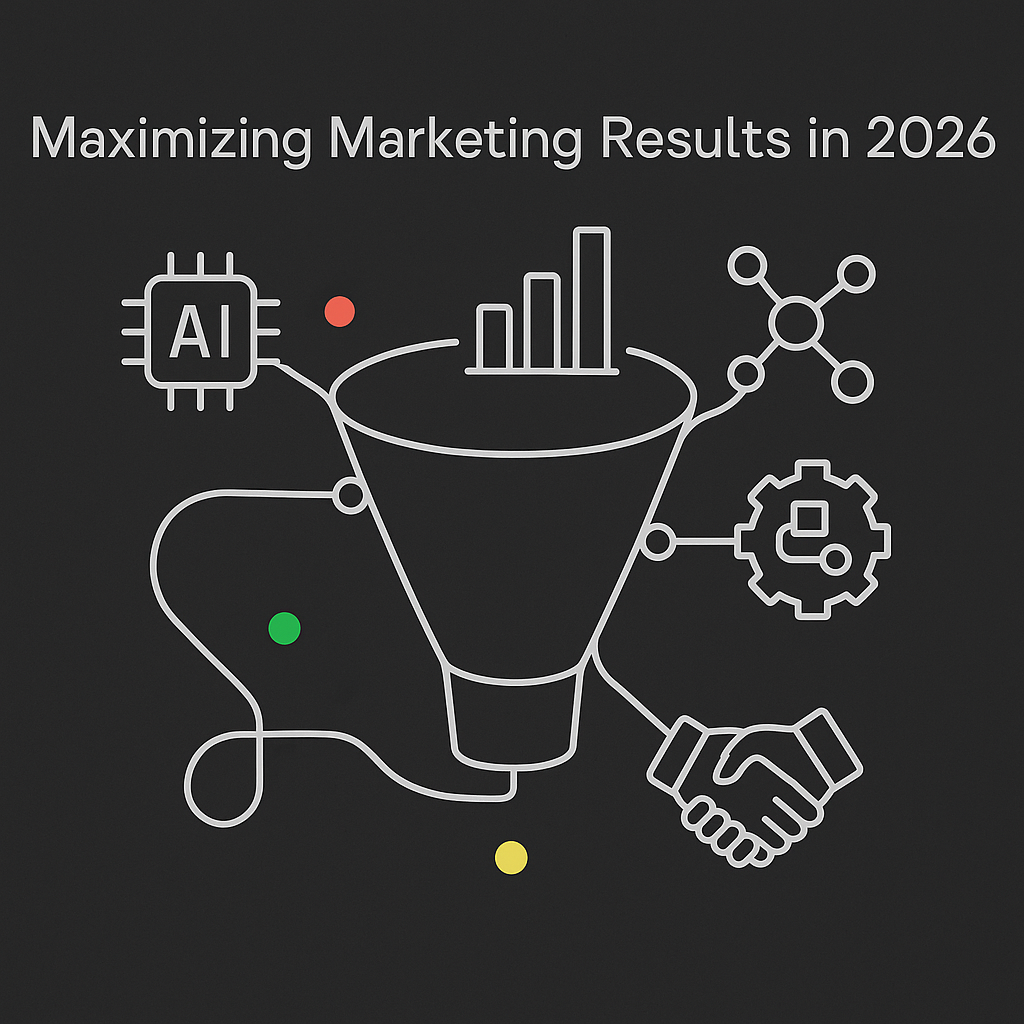
<p>In 2025, 63 percent of businesses reported stagnant marketing ROI, and experts predict that the gap in marketing results will only widen by 2026 if nothing changes. The digital landscape is more complex than ever, with AI-driven tools, omnichannel customer journeys, and shifting data privacy rules rewriting the playbook.</p> <p>Marketing leaders and agencies are under pressure to deliver stronger marketing results to stay ahead of the competition. This guide will walk you through the data-driven steps you need to set measurable goals, leverage AI and data, optimize your channel mix, enhance reporting, build collaboration, and stay ahead of the trends, so you can maximize your impact in 2026.</p> <h2>Setting the Foundation: Defining Measurable Marketing Goals for 2026</h2> <p>Setting the right foundation is the secret to standout marketing results in 2026. The rules of the game are changing, and fuzzy targets just won’t cut it. Instead, marketers need goals that are laser-focused, measurable, and built to adapt.</p> <img src="https://xqvnmkjynbkcujcrtubi.supabase.co/storage/v1/object/public/article-images/6ecc4ba7-6748-4108-8a03-bf5c6859a104/article-6ecc4ba7-6748-4108-8a0-informational-diagram-showing-the-flow-from-busine-0-9ttxx0.jpg" alt="Setting the Foundation: Defining Measurable Marketing Goals for 2026"><p><strong>Why SMART Goals Matter in 2026</strong></p> <p>Let’s get straight to it: setting SMART (Specific, Measurable, Achievable, Relevant, Time-bound) goals is more than a buzzword. In the 2026 business landscape, complexity is the norm and distractions are everywhere. SMART goals act as your North Star, keeping your team focused on the marketing results that actually move the needle.</p> <p>A SMART goal isn’t just “grow our audience.” It’s “increase marketing-sourced revenue by 20 percent by Q3 2026.” This clarity is what separates high-performing teams from those who chase their tails.</p> <p><strong>Aligning Marketing Goals with Business KPIs</strong></p> <p>Here’s the truth: marketing results mean nothing if they’re out of sync with core business KPIs. The most impactful teams work backwards from what matters most to the board—think revenue growth, customer lifetime value, or new product adoption.</p> <p>To make this alignment work, start by mapping each marketing objective to a business outcome. For example:</p> <table> <thead> <tr> <th>Marketing Objective</th> <th>Business KPI Aligned</th> </tr> </thead> <tbody><tr> <td>Generate 500 qualified leads/month</td> <td>Sales pipeline growth</td> </tr> <tr> <td>Improve email open rates by 30 percent</td> <td>Customer engagement</td> </tr> <tr> <td>Increase high-value conversions by 15 percent</td> <td>Revenue growth</td> </tr> </tbody></table> <p>This approach ensures every campaign, channel, and tactic is directly tied to measurable business impact. That’s how you get marketing results that matter.</p> <p><strong>From Vanity Metrics to Actionable Performance Indicators</strong></p> <p>Let’s face it, vanity metrics are tempting. But impressions and likes rarely impress the C-suite. The shift for 2026 is all about actionable metrics—think pipeline value, marketing-attributed revenue, or cost per high-value lead.</p> <p>Want to dig deeper into tracking the right numbers? Check out this guide on <a href="https://www.catchdigital.io/blog/roi-marketing-services" target="_blank" rel="noopener noreferrer">Measuring marketing ROI effectively</a> for methods that help you prove your impact.</p> <p><strong>Frameworks to Drive Goal-Setting</strong></p> <p>Two frameworks are leading the charge for outcome-focused marketing results: OKRs and growth loops.</p> <table> <thead> <tr> <th>Framework</th> <th>How It Works</th> <th>Example for 2026</th> </tr> </thead> <tbody><tr> <td>OKRs</td> <td>Set Objectives (goals) and Key Results (metrics)</td> <td>Objective: Boost recurring revenue. KR: Grow monthly active users by 25 percent.</td> </tr> <tr> <td>Growth Loops</td> <td>Create self-reinforcing cycles that drive growth</td> <td>Example: Content attracts users → users share content → new users join, fueling more growth.</td> </tr> </tbody></table> <p>Using these frameworks brings structure and repeatability to your goal-setting, making it easier to optimize for real marketing results.</p> <p><strong>Benchmarking: Internal and Industry Standards</strong></p> <p>How do you know if your goals are ambitious or just average? Benchmarking is your answer. Compare your targets to industry standards and your own historical data. For instance, if the industry average for digital marketing ROI is 5:1, set your sights on beating it.</p> <p>Quick Stat Block:</p> <ul> <li>72 percent of boards now require quarterly benchmarking of marketing results.</li> <li>Companies using historical benchmarks are 27 percent more likely to hit stretch targets.</li> </ul> <p><strong>Agile Adjustments and Regular Goal Reviews</strong></p> <p>The best teams don’t just set goals and forget them. They schedule monthly or quarterly reviews to check progress. If a campaign underperforms, pivot fast. If you’re ahead of pace, double down.</p> <ul> <li>Set review cadences (monthly/quarterly)</li> <li>Use dashboards for real-time tracking</li> <li>Involve both marketing and sales in reviews</li> </ul> <p>This approach builds a culture of accountability and keeps your marketing results on track.</p> <p><strong>Case Study: SaaS Success Through Goal Redefinition</strong></p> <p>A leading SaaS company faced stagnant pipeline growth. Instead of focusing on top-of-funnel leads, they redefined their marketing goals around high-value conversions and customer expansion. By aligning their targets with sales and tracking only metrics tied to revenue, they exceeded their annual sales target by 18 percent.</p> <p>The lesson? When you set clear, business-aligned goals and review them regularly, you set the stage for breakthrough marketing results in 2026.</p> <h2>Leveraging Data, AI, and Automation to Drive Results</h2> <p>Modern marketing results hinge on how well you harness data, AI, and automation. In 2026, the difference between average and exceptional marketing results often comes down to how quickly and accurately you turn insights into action. Let’s break down the three pillars that will drive your performance to new heights.</p> <img src="https://xqvnmkjynbkcujcrtubi.supabase.co/storage/v1/object/public/article-images/6ecc4ba7-6748-4108-8a03-bf5c6859a104/article-6ecc4ba7-6748-4108-8a0-an-informational-diagram-showing-the-flow-of-marke-1-kkkvn2.jpg" alt="Leveraging Data, AI, and Automation to Drive Results"><h3>The Power of Data-Driven Decision Making</h3> <p>To achieve top-tier marketing results in 2026, you need to master the art of data-driven decision making. That starts with collecting and integrating three types of data: first-party (your owned data from CRM and analytics), third-party (external sources), and zero-party (data users willingly share).</p> <p>When you unify these sources into a central platform, you create a 360-degree view of your customer. This means smarter targeting, more relevant campaigns, and improved marketing results. Unified data dashboards help teams spot trends at a glance, reducing the risk of missing critical insights due to siloed data.</p> <p>Consider this: agencies that automate reporting can save up to $18,500 each year in labor costs. This frees up time to focus on optimizing marketing results instead of wrangling spreadsheets.</p> <p>Key data sources to prioritize:</p> <ul> <li>CRM systems for customer profiles and history</li> <li>Web analytics for behavioral patterns</li> <li>Ad platforms for campaign performance</li> <li>Direct customer feedback for qualitative insights</li> </ul> <p>The takeaway? Centralize your data, break down silos, and make every marketing results conversation grounded in real numbers.</p> <h3>Implementing AI for Smarter Marketing in 2026</h3> <p>AI is rapidly transforming how brands achieve better marketing results. Think of AI as your digital co-pilot, analyzing massive datasets and uncovering patterns humans might miss.</p> <p>Today’s leading teams use AI for predictive analytics, dynamic creative optimization, and automated bidding. Predictive models can forecast which prospects are most likely to convert, letting you target resources where they’ll drive the most marketing results.</p> <p>AI-driven personalization allows you to deliver tailored messaging at scale. Segmentation becomes more granular, so every touchpoint feels relevant. Attribution models powered by AI are essential for mapping multi-touch customer journeys accurately. If you want to get attribution right, check out this <a href="https://www.catchdigital.io/blog/advanced-utm-attribution-tracking-guide" target="_blank" rel="noopener noreferrer">Advanced UTM attribution tracking guide</a> for actionable techniques that can elevate your marketing results measurement.</p> <p>Here’s a real-world example: a SaaS firm implemented AI-driven lead scoring and saw a 17% year-over-year jump in conversion rates. That’s the kind of lift you want in your marketing results.</p> <p>Of course, as AI adoption grows, so do data privacy and ethical considerations. Always ensure your AI solutions comply with regulations and respect customer trust. The future of marketing results will be won by those who balance innovation with responsibility.</p> <h3>Automating and Streamlining Marketing Workflows</h3> <p>If you want to maximize marketing results, automation is non-negotiable. Automation tools handle repetitive tasks, so your team can focus on strategy and creativity instead of manual busywork.</p> <p>Common automation use cases include:</p> <ul> <li>Triggered email sequences for nurturing leads</li> <li>Chatbots for instant customer support</li> <li>Automated social media posting and scheduling</li> </ul> <p>Automated reporting is another game-changer. When agencies automate monthly reporting, they see higher client retention and better transparency, both of which feed directly into improved marketing results.</p> <p>Here’s a quick checklist of key workflows to automate by 2026:</p> <ul> <li>Lead nurturing campaigns</li> <li>Multi-channel campaign management</li> <li>Performance reporting and analytics</li> <li>Social listening and engagement</li> <li>Budget and spend optimization</li> </ul> <p>The bottom line? Streamlining your workflows with automation isn’t just about saving time—it’s about unlocking the full potential of your marketing results.</p> <h2>Optimizing Channel Strategy for Omnichannel Success</h2> <p>A winning marketing results strategy in 2026 is built on one thing: omnichannel excellence. With so many platforms and touchpoints, your channel mix can make or break your outcomes. The secret? Integrating the right channels, ensuring seamless messaging, and relentlessly optimizing performance.</p> <img src="https://xqvnmkjynbkcujcrtubi.supabase.co/storage/v1/object/public/article-images/6ecc4ba7-6748-4108-8a03-bf5c6859a104/article-6ecc4ba7-6748-4108-8a0-informational-diagram-showing-an-omnichannel-marke-2-mg3g9t.jpg" alt="Optimizing Channel Strategy for Omnichannel Success"><h3>Selecting and Integrating High-Impact Channels</h3> <p>Choosing the right channels is foundational for maximizing marketing results. In 2026, the top performers include paid search, social media, video, influencer partnerships, and emerging platforms like voice assistants and AR experiences.</p> <p>Audiences are no longer tied to a single platform. Instead, they weave between devices and channels, expecting brands to keep up. Multi-channel campaigns now outperform single-channel efforts by 30% in conversion rates. That means a unified approach is no longer optional—it is the new baseline.</p> <p>Here is a simple framework to guide your channel selection:</p> <ul> <li><strong>Map your audience:</strong> Where do they spend their time online?</li> <li><strong>Align with business goals:</strong> Does the channel support your growth targets?</li> <li><strong>Analyze past performance:</strong> What has delivered strong marketing results before?</li> <li><strong>Pilot and iterate:</strong> Test emerging channels, but double down on what works.</li> </ul> <p>For example, an e-commerce brand grew average order value by integrating email, SMS, and retargeting ads—meeting customers at every step. The right mix, tailored to your target audience, sets the stage for superior marketing results.</p> <h3>Orchestrating Consistent Messaging Across Journeys</h3> <p>Once your channels are chosen, consistency becomes your superpower. Customers interact with your brand across multiple touchpoints, and a cohesive message builds trust and drives stronger marketing results.</p> <p>Start by unifying your brand voice and visuals across platforms. Use content calendars and asset management tools to keep messaging synchronized. Personalization matters too—cross-channel data lets you tailor offers, recommendations, and creative for each segment.</p> <p>Consider this: brands that maintain consistent messaging across all channels enjoy a 25% boost in customer retention. That is because every interaction feels familiar, reliable, and relevant. Here are some strategies for success:</p> <ul> <li><strong>Centralize creative assets:</strong> Ensure all teams access the latest visuals and copy.</li> <li><strong>Automate personalization:</strong> Use audience data to adjust messaging in real time.</li> <li><strong>Monitor feedback:</strong> Regularly review customer responses to refine your approach.</li> </ul> <p>By delivering a seamless experience, you build loyalty and amplify your marketing results at every touchpoint.</p> <h3>Measuring and Optimizing Channel Performance</h3> <p>Measurement is where your omnichannel strategy translates into real marketing results. Each channel demands its own set of KPIs—think ROAS for paid search, engagement rate for social, and CAC for organic. But tracking is only half the battle.</p> <p>Attribution models are your compass. Whether you use first-touch, last-touch, or multi-touch, the goal is clear: link every marketing activity to revenue. Boards and executives want proof that spend drives impact.</p> <p>Here is a quick optimization checklist:</p> <ul> <li><strong>A/B test campaigns:</strong> Continuously refine creative and offers.</li> <li><strong>Benchmark performance:</strong> Compare against <a href="https://www.diamond-group.co/blog/whats-a-good-roi-for-digital-marketing-in-2026" target="_blank" rel="nofollow noopener noreferrer">Digital Marketing ROI Benchmarks</a> to set realistic goals.</li> <li><strong>Reallocate budget:</strong> Shift resources to high-performing channels.</li> <li><strong>Automate reporting:</strong> Speed up insights and transparency.</li> </ul> <p>A B2B company, for example, used attribution insights to reallocate spend, boosting ROI by 40%. With a disciplined approach to measurement, you can drive measurable marketing results and keep your strategy ahead of the curve.</p> <h2>Enhancing Reporting and Communication for Maximum Impact</h2> <p>Clear, actionable reporting is the linchpin for maximizing marketing results in 2026. As marketing leaders face growing demands for transparency and ROI, how you present data can make the difference between stakeholder buy-in and missed opportunities. Let’s break down exactly how to elevate your reporting and communication practices for the year ahead.</p> <img src="https://xqvnmkjynbkcujcrtubi.supabase.co/storage/v1/object/public/article-images/6ecc4ba7-6748-4108-8a03-bf5c6859a104/article-6ecc4ba7-6748-4108-8a0-informational-graphic-showing-a-modern-minimalist--3-tuyiv8.jpg" alt="Enhancing Reporting and Communication for Maximum Impact"><h3>Building Clear, Actionable Marketing Reports</h3> <p>Effective marketing results depend not just on data, but on how you communicate that data. Reports should be concise, visually engaging, and focused on outcomes, not just activity. Avoid overwhelming your audience with endless spreadsheets. Instead, highlight trends and actionable insights using visuals like graphs and charts.</p> <p>A best practice is to structure reports with clear headers and sections. Start with an executive summary, followed by channel breakdowns, key insights, and next steps. This format helps stakeholders quickly grasp the story behind the numbers. Here’s a sample template:</p> <table> <thead> <tr> <th>Section</th> <th>Purpose</th> </tr> </thead> <tbody><tr> <td>Executive Summary</td> <td>Key outcomes and highlights</td> </tr> <tr> <td>Channel Breakdown</td> <td>Performance by marketing channel</td> </tr> <tr> <td>Key Insights</td> <td>Trends, wins, and challenges</td> </tr> <tr> <td>Next Steps</td> <td>Recommended actions and optimizations</td> </tr> </tbody></table> <p>Focusing on outcomes is essential. Boards and executives want to see tangible marketing results, such as revenue growth or lead generation, rather than vanity metrics. Using visuals and clear storytelling not only increases understanding but can also help agencies unlock upsell opportunities. For example, one agency improved upsell rates by presenting ROI-driven reports that directly tied efforts to business growth. For more, explore <a href="https://www.catchdigital.io/blog/roi-growth-agency" target="_blank" rel="noopener noreferrer">ROI growth strategies for agencies</a>.</p> <h3>Adding Context and Insights to Data</h3> <p>Raw numbers alone rarely tell the full story of your marketing results. Adding commentary and context transforms data from static figures to actionable intelligence. Include industry benchmarks or your own historical data for comparison. This contextual layer helps stakeholders understand whether a 10% increase in engagement is truly significant.</p> <p>Transparency is also key. Acknowledge both successes and areas needing improvement. Boards respect honest reporting and want to see a plan for overcoming any shortfalls. For instance, if a campaign misses its target, outline corrective actions and what’s being adjusted. This builds trust and keeps everyone aligned on the path to better marketing results.</p> <h3>Communicating Results to Stakeholders</h3> <p>Tailor your reports to the needs of each audience. Executives may prefer high-level overviews, while marketing teams need deeper dives. Schedule regular reporting—monthly or quarterly—to keep everyone informed and engaged with marketing results. </p> <p>Periodic review meetings create space to answer questions, clarify results, and align on next steps. For board-level presentations, include this checklist:</p> <ul> <li>Outcomes and ROI</li> <li>Alignment with business goals</li> <li>Emerging trends and key insights</li> <li>Actionable recommendations</li> </ul> <p>Collaborate with sales and other departments to present unified marketing results. This not only strengthens your business case for future investment but also ensures everyone is working toward the same objectives.</p> <h2>Fostering Cross-Functional Collaboration for Greater ROI</h2> <p>Unlocking the true potential of marketing results in 2026 requires more than top-notch tactics or clever campaigns. It demands genuine cross-functional collaboration—where marketing, sales, product, and customer success operate as one high-performing team, not isolated silos.</p> <div data-youtube-video> <iframe src="https://www.youtube.com/embed/aZ0l6lMsNvU" frameborder="0" allowfullscreen data-type="youtube" data-youtube-video-id="aZ0l6lMsNvU" ></iframe> </div> <h3>Aligning Teams for Unified Goals</h3> <p>When teams align their goals, the impact on marketing results is immediate and measurable. Joint planning sessions between marketing and sales clarify target audiences, messaging priorities, and lead definitions. Product teams bring customer insights, helping shape campaigns that resonate and convert.</p> <p>Consider this: companies that set shared KPIs across departments see stronger accountability and faster decision-making. Instead of finger-pointing, everyone works toward the same outcomes. Competitor data shows that close collaboration with sales can increase lead-to-revenue conversion rates by up to 30 percent, directly boosting marketing results.</p> <h3>Tools and Processes for Seamless Collaboration</h3> <p>Effective collaboration does not happen by accident—it is built on smart processes and the right tools. Project management platforms, such as shared dashboards and calendars, keep everyone on track. Regular cross-team syncs ensure insights flow freely, empowering teams to pivot quickly when new opportunities or obstacles arise.</p> <p>Feedback loops are critical. By gathering input from customer success and product, marketing can refine campaigns and messaging, ensuring every touchpoint supports stronger marketing results. For more on aligning strategy and execution, see <a href="https://www.catchdigital.io/service/digital-marketing-strategy" target="_blank" rel="noopener noreferrer">Optimizing digital marketing strategies</a>.</p> <p><strong>Quick Comparison Table: Collaboration Impact</strong></p> <table> <thead> <tr> <th>Collaboration Level</th> <th>Outcome for Marketing Results</th> </tr> </thead> <tbody><tr> <td>Siloed</td> <td>Disjointed campaigns, missed targets</td> </tr> <tr> <td>Integrated</td> <td>Unified goals, higher ROI, agility</td> </tr> </tbody></table> <h3>Real-World Impact: Case Studies and Examples</h3> <p>Cross-functional teamwork is not just theory—it delivers tangible results. Imagine a SaaS company where marketing and product teams jointly develop launch campaigns using real customer feedback. The result? Messaging that speaks directly to pain points, driving engagement and accelerating adoption.</p> <p>In another scenario, a cross-functional team launches a new product. By integrating marketing, sales, and customer success from day one, they cut time-to-market and achieve higher early adoption rates. These stories are not outliers—they are becoming the standard for organizations committed to maximizing marketing results.</p> <h3>Best Practices and Takeaways</h3> <p>To get the most from cross-functional collaboration, start with regular joint planning sessions and set shared KPIs. Use tools that make information visible and actionable for all stakeholders. Foster a culture where feedback is valued and acted upon.</p> <p>Remember, marketing is no longer a service department—it is a strategic partner driving business growth. Organizations that embrace this mindset will see their marketing results soar in 2026 and beyond.</p> <h2>Staying Ahead: Monitoring Trends and Adapting Strategies for 2026</h2> <p>Keeping your finger on the pulse is essential if you want to drive standout marketing results in 2026. The landscape is changing faster than ever, with AI, data privacy, and consumer habits in constant motion. If you want to outperform the competition, you need to spot trends early, adapt fast, and make every move count.</p> <p><strong>2026’s Must-Watch Marketing Trends</strong></p> <table> <thead> <tr> <th>Trend</th> <th>What It Means for You</th> <th>Why It Matters for Marketing Results</th> </tr> </thead> <tbody><tr> <td>Generative AI in Creative</td> <td>AI tools create and optimize content at scale</td> <td>Boosts efficiency and personalization; 90% of video ads use GenAI <a href="https://www.tvtechnology.com/news/nearly-90-percent-of-advertisers-will-use-gen-ai-to-build-video-ads-according-to-iab" target="_blank" rel="nofollow noopener noreferrer">AI's Impact on Video Advertising</a></td> </tr> <tr> <td>Privacy-First Marketing</td> <td>New regulations and consumer expectations shape data use</td> <td>Builds trust, protects brand, and ensures compliance</td> </tr> <tr> <td>Interactive & AR Content</td> <td>Immersive experiences, shoppable media, AR try-ons</td> <td>Drives engagement, sets you apart from static competitors</td> </tr> <tr> <td>New Consumer Behaviors</td> <td>Gen Z and Alpha demand authenticity, speed, and value</td> <td>Forces brands to rethink channels and content</td> </tr> </tbody></table> <p>To translate these trends into real marketing results, you need an agile, data-driven approach. Start by carving out time for regular trend monitoring. Set up alerts for industry reports, competitor moves, and emerging tech. Use dashboards to track what’s working and what’s losing steam. Benchmark your own performance against up-to-date stats from resources like <a href="https://www.demandsage.com/digital-marketing-statistics/" target="_blank" rel="nofollow noopener noreferrer">Comprehensive Digital Marketing Statistics</a>.</p> <p><strong>Framework for Trend Monitoring and Adaptation</strong></p> <ul> <li><strong>Monthly competitor analysis:</strong> Who’s innovating, and how?</li> <li><strong>Quarterly industry report reviews:</strong> What’s changing in your sector?</li> <li><strong>Customer insight loops:</strong> Ask, listen, and adapt to real feedback.</li> <li><strong>Experimentation budget:</strong> Dedicate 10–15% of spend to test new channels or formats.</li> <li><strong>Shiny object filter:</strong> Only pursue trends that align with your business goals and audience.</li> </ul> <p>Want a quick way to decide if a trend deserves your attention? Use this checklist:</p> <p><strong>Trend Investment Checklist</strong></p> <ul> <li>Does it help drive core marketing results (revenue, retention, acquisition)?</li> <li>Is it backed by data and relevant benchmarks?</li> <li>Can your team execute it with current resources or partners?</li> <li>Will it deliver value to your target audience?</li> <li>Does it support your long-term brand vision?</li> </ul> <p>Brands that stay ahead do not just chase every new thing. They focus on the trends that move the needle for their marketing results. For example, a retailer that jumped early into AR-powered ads captured market share before competitors even noticed, thanks to immersive product demos and personalized experiences.</p> <p>The bottom line? Staying ahead is not about being first in line for every shiny object. It is about continuous learning, smart investment, and relentless focus on the marketing results that matter most.<br><br>You’ve just explored the building blocks of marketing success for 2026—from setting razor-sharp goals to harnessing AI, optimizing every channel, and keeping your strategy ahead of the curve. But if you’re ready to go beyond reading and actually put these insights to work for your business, why not get personal guidance tailored to your unique challenges and goals? Let’s cut through the noise together and map out a plan that delivers real, predictable growth. If you’re serious about taking your results to the next level, <a href="https://www.catchdigital.io/book-a-consultation" target="_blank" rel="noopener noreferrer">Book a Strategy Call</a> and let’s get started.</p>